
Yet another green kyanite, this one is reportedly coming from Odisha (formerly Orissa) in India. The Indian state in known to produce many gemstones such as ruby, sapphire, zircon, cordierite, garnet, kyanite, sillimanite, emerald, aquamarine, chrysoberyl and even diamond. End of 2013, some greenish-blue (steal-blue) kyanites from Odisha appeared in the market. They are known to be a Cr-rich variety of kyanite which often hosts characteristic black inclusions of ilmenite and zircon crystals.
The kyanite (figure 1) is green or better to describe it as slightly-yellowish-green in warm white light, bluish-green in cool-white light and grayish-bluish-green in incandescent light. It does not include black inclusions as reported for blue from from Odisha area but a lot of oriented and white inclusions giving the 'foggy' appearance and impairing somewhat the transparency.
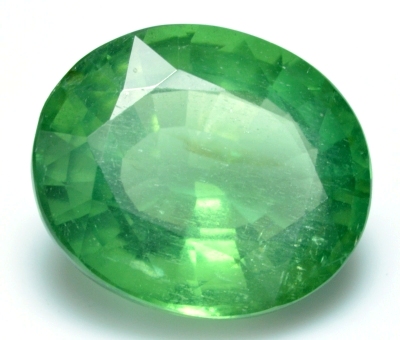 Figure 1. 9.58 ct green kyanite reportedly from Odisha, India
| Shape | oval |
| Size | 14.0 x 12.0 x 6.9 mm |
| Color | green but the hue varies with light sources from slightly-bluish green to yellowish green to slightly-grayish green |
| Lustre | vitreous |
| Weight | 9.58 ct |
| SG | 3.67 |
| RI | 1.715 - 1.732 |
| DR | 0.017 B+ |
| Pleochroism | moderate bluish-green / yellowish-green / (very light yellowish-green) |
| Polariscope / Conoscope | light/dark 4 times / 360°, optical axis not found... |
| SWUV | inert |
| LWUV | inert |
| Magnetic susceptibility | very weak with N52 |
Table 1. Observational and measured properties
Infrared reflectance spectroscopy:
The IR reflectance spectrum (figure 2), acquired from the table, exhibits a characteristic spectrum of kyanite specie.
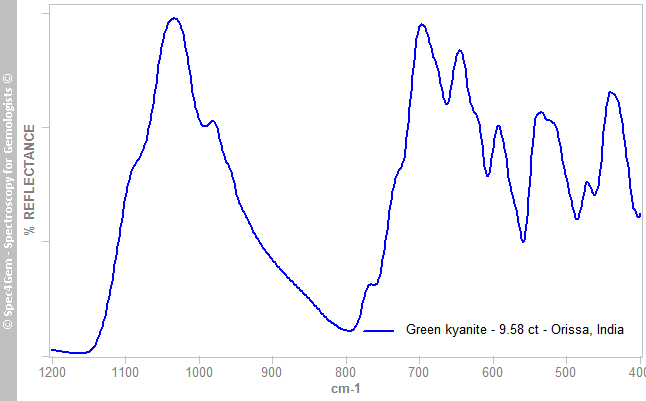 Figure 2. IR reflectance spectrum of the 9.58 ct green kyanite from Odisha, India, acquired from the table, exibits a characteristic spectrum of kyanite specie.
 UV-VIS-NIR spectroscopy:
The UV-Vis-NIR absorption spectrum (figure 3) was acquired with the light path perpendicular to the table with the light entering the pavilion at a point located mid-way between the culet and the girdle on the long axis.
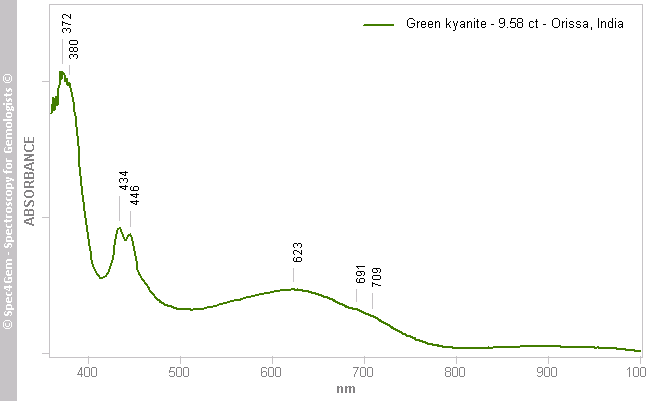 Figure 3. Unpolarized UV-Vis-NIR absorption spectrum of the 9.58 ct green kyanite from Odisha, India exhibits features at 372, 380, 434 and 446 nm related to Fe3+ as well as a broad band centered at 623 nm. Weak features attributed to Cr3+ are also present at 691 and 709 nm.
The unpolarized UV-Vis-NIR absorption spectrum exhibits features at 372, 380, 434 and 446 nm related to Fe3+ as well as a broad band centered at 623 nm (Faye and Nickel, 1969)[2], (Parkin et al., 1977)[1]. Weak features unambiguously attributed to Cr3+ are also present at 691 and 709 nm. The Fe2+↔Ti4+ IVCT (White and White, 1967 - Parkin et al, 1977 - Ghera et al, 1986)[1] or the now preferred Fe2+↔Fe3+ IVCT (Faye and Nickel, 1969)[2], (Smith and Strens, 1976 - Burns, 1981)[1] do not explain the 623 nm band because the Fe2+ CF transitions absorption band in the 800-850 nm region (Faye and Nickel, 1969)[2] is not observed in this spectrum. Even if the spectrum is related to Fe3+, its 1020 nm band is not observed.
The 623 nm band has a comparatively low absorbance compared to the Fe3+ doublet at 434 and 446 nm but not as low as for the 10.15 ct yellowish-green kyanite from Mirerani, Tanzania. The stronger absorbption on the yellow and red region can explain the green and bluish-green color.
Two extra spectra were acquired with polarizing filters that have a limited band pass (420 - 800 nm). The collected spectra (figure 4) match the E||γ and E||β directions. The Fe3+ doublet at 434 and 446 nm is invariable except its absorbance which is greater in E||γ direction. The evident Cr3+ features at 654, 670, 681 and 710 nm also depends on polarization, they are stronger in E||γ direction than in the E||β one. The 620 nm band has a shoulder around 580 nm in the E||γ direction that does not exist in the E||β direction spectrum where the 620 nm band shifts to 600 nm with a reduced band width.
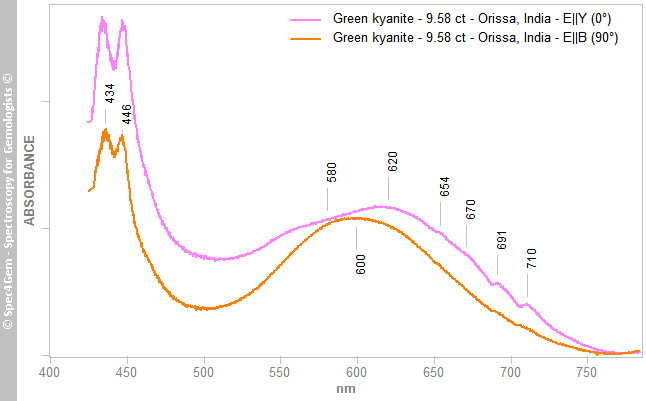 Figure 4. Polarized UV-Vis absorption spectra of the 9.58 ct green kyanite from Odisha, India for the E||γ (pink spectrum) and E||β (orange spectrum) directions. The Fe3+ doublet at 434 and 446 nm is invariable except its absorbance is greater in E||γ direction. The evident Cr3+ features at 654, 670, 681 and 710 nm also depends on polarization, they are stronger in E||γ direction than in the E||β one. The 620 nm band has a shoulder around 580 nm in the E||γ direction although it does not exist in the E||β direction spectrum where the 620 nm band shifts to 600 nm with a reduced band width .
The polarization dependency of the 600 - 620 nm band suggests this band or bands set is not only the result of Fe3+ but that of Cr3+ as well. The spectrum is similar to the spectra of the 3.70 ct greenish-blue kyanite from Orissa appeared in 2013 except the Fe3+ doublet at 434 and 446 nm is more prominent and the 600-620 nm bands are less intense in this green kyanite. Similar spectra have been observed in blue kyanite colored by both Cr3+ and Fe3+, such as the blue kyanite sample GR1692 from Kenya[4].
The moderate difference between the E||γ and the E||β spectra explains the moderate pleochroism of this kyanite even if the E||α was not taken in consideration.
From all these observation, it is possible to conclude that the green color is not exclusively attributed to Fe3+ but to Fe3+ jointly with Cr3+.
Photoluminescence spectroscopy:
Although the gemstone is inert under the SW and LW lamps, a 405 nm laser pointer induces red luminescence. The photoluminescence spectrum (figure 5) excited with a 405 nm laser was acquired without specifically orienting the laser beam within the stone.
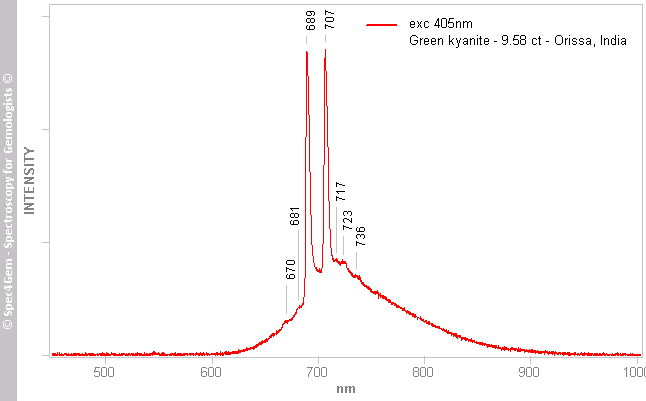 Figure 5. Photoluminescence spectrum of the 9.58 ct green kyanite from Odisha, India showing the R2 & R1 Cr3+ lines respectively at 689 and 707 nm.
This green kyanite shows a rather strong red luminescence attributed to the R2 & R1 lines of Cr3+ respectively at 689 and 707 nm (Gaft et al.)[5].
Conclusion:
The green color of this 9.58 ct kyanite from Odisha in India is the result of the Fe3+ and Cr3+ ions together.
[1] Mineralogical Applications of Crystal Field Theory, R. G. Burns, 2005, ISBN: 0521017858 | 978-0521017855
[2] On the origin of colour and pleohroism of kyanite, G. H. Faye, E. H. Nickel, The Canadian Mineralogist, Vol 30, No 35, 1969
[3] Blue colour-changing kyanite from East Africa, G. Bosshart et al., Journal of Gemmology, Vol. 18, No. 3, 1982, pp. 205–212
[4] Kyanite Visible Spectra - List of Visible Data Files on the Caltech Mineral Spectroscopy Server
[5] Modern Luminescence Spectroscopy of Minerals and Materials, 2nd Edition, M. Gaft, R. Reisfeld, G. Panczer, Springer Editor, ISBN: 9783319247632