
A small amount of a bluish-green material was found during the 52rd edition of the Sainte-Marie-Aux-Mines mineral show. The material was proposed as gem silica which was and is still trendy. A 15 grams piece of rough material was acquired for studying.
The Gem silica is the trade name for a rare gemstone with a vivid bluish-green to greenish-blue hue. Also known as "gem silica chrysocolla", "chrysocolla chalcedony", it is actually a member of the chalcedony family and not, strictly speaking, a variety of chrysocolla at all. Despite that, such a chalcedony variety gets its color from its chrysocolla inclusions and it is thus indirectly colored by copper.
Gem silica is mainly mined in Arizona (USA) and occasionally with limited amounts from locations in New Mexico, Mexico, Peru, Taiwan, and the Philippines.
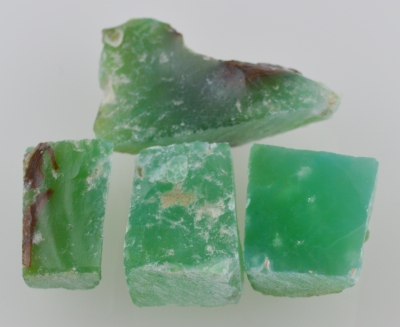 Figure 1. 4 pieces from 11 to 18 ct sawn from the 15 grams rough.
| Shape | sawn piece of rough with a polished face |
| Size | 14 x 13 x 9.5 mm |
| Color | bluish-green |
| Lustre | vitreous |
| Weight | 18.01 (only 17.95 after a year drying, reverts to 18.01 after soaking in water) -> porous ? |
| SG | 2.59 |
| RI | 1.543 |
| DR | - |
| Pleochroism | - |
| Polariscope / Conoscope | stays light through 360° -> polycrystalline |
| SWUV | inert |
| LWUV | inert |
| Magnetic susceptibility | < 0 (slighly diamagnetic) |
Table 1. Observational and measured properties
Infrared reflectance spectroscopy:
The IR reflectance spectrum was acquired from the table. The spectrum (figure 2) is characteristic of quartz material, the weak 690 cm-1 band and the 780 and 800 cm-1 bands not as sharp as in crystalline quartz are consistent with chalcedony (a cryptocrytalline / polycrystalline quartz).
 Figure 2. The IR reflectance spectrum of the 1.24 ct green-blue gemstone is characteristic of chalcedony with a weak 692 cm-1 band and the 783 and 800 cm-1 bands not as sharp as in crystalline quartz.
UV-VIS-NIR spectroscopy:
The UV-Vis-NIR spectrum was acquired with the light path crossing from culet to table, anyway since the material is polycrytalline the orientation does not affect the absorption / transmission spectrum.
 Figure 3. UV-Vis spectrum of the bluish-green rough showing nm, usually attributed to Cu2+ [1][2][9][10].
The UV-Vis-PIR spectrum (figure 2) shows a minimal absorption around 548 nm and a maximum absorption near 723 nm. The transmission window between 470 nm and 620 nm explains the observed bluish-green color of the material. The main absorption in such chalcedony material is usually attributed to Cu2+ [1][2][9][10]. It is important to note that the main absorption at 723 is not asymmetric as it usually is in chalcedony colored by chrysocolla, extending towards the NIR.
Photoluminescence spectroscopy:
No luminescence observed with the following sources : 254, 280, 365 and 405 nm.
Conclusion:
This greenish-blue material is chalcedony (polycrystalline quartz) colored by Cu2+, but it not clear at all if it was chrysocolla or not, subsequently it is difficult to qualified it "gem silica" trade name according to the latest definition that state "colored by chrysocolla microscopic inclusions".
[1] Mineralogical Applications of Crystal Field Theory, R. G. Burns, 2005, ISBN: 0521017858 | 978-0521017855 pp. 235–239 - Andersen (1978)
[2] Natural-Colored Chrome Chalcedony Identified Using Laser Ablation–Inductively Coupled Plasma–Mass Spectrometry (LA-ICP-MS). Andy Shen, GIA Laboratory, Carlsbad
[3] Nathan Renfro, GIA, Carlsbad. A new natural-color bluish green chalcedony. Gems & Gemmology, 2015, Winter, pp. 452–454.
[4] Blue Chrysocolla Chalcedony from Peru. Journal of Gemmology, 2014, volume 34, No.1, pp. 9–10
[5] Chrysocolla Chalcedony from Spain. Journal of Gemmology, 2015, volume 34, No.6, p. 472
[6] Chrysocolla chalcedony from Acari, Peru. Gems & Gemmology, 2010, Summer, pp. 148–149.
[7] Dyed chalcedony resembling chrysocolla. Gems & Gemmology, 2008, Winter, p. 379.
[8] Chrysocolla chalcedony from Iran/Armenia area Gems & Gemmology, 2007, Winter, pp. 376–377.
[9] Dyed blue chalcedony detected by UV-Vis-NIR spectroscopy. Gems & Gemmology, 2007, Fall, pp. 245–246.
[10] Identification of Dyed Chrysocolla Chalcedony. Gems & Gemmology, 2006, Fall, p. 140.
[11] Pink opal from Monte Rosa, Peru. Gems & Gemmology, 2006, Summer, pp. 176–177.
[12] Adularescent chalcedony from Iran. Gems & Gemmology, 2004, Winter, p. 337.
[13] Chrysocolla-colored chalcedony from Mexico. Gems & Gemmology, 1992, Spring, pp. 59–60.