
Gem silica has become in the past years a prominent gemstone in the market, at least the demand is quite height.
Gem silica is the trade name for a rare gemstone with a vivid bluish-green to greenish-blue hue. Also known as "gem silica chrysocolla", "chrysocolla chalcedony", it is actually a member of the chalcedony family and not, strictly speaking, a variety of chrysocolla at all. Despite that, such a chalcedony variety gets its color from its chrysocolla inclusions and it is thus indirectly colored by copper.
The gemstone analyzed here was reported as a gem silica from Arizona, USA, one of the most famous sources of such material.
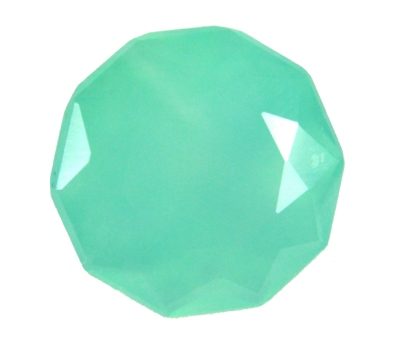 Figure 1. The reportedly 1.24 ct green-blue gem silica from Arizona, USA
| Shape | "round" |
| Size | Ø 7.3 mm |
| Color | green-blue (the color is not homogeneous in the whole stone, some zones are lighter in color) |
| Lustre | vitreous |
| Weight | 1.24 |
| SG | 2.58 |
| RI | 1.538 |
| DR | - |
| Pleochroism | - |
| Polariscope / Conoscope | stays light through 360° |
| SWUV | inert |
| LWUV | inert |
| Magnetic susceptibility | inert |
Table 1. Observational and measured properties
Infrared reflectance spectroscopy:
The IR reflectance spectrum was acquired from the table. The spectrum (figure 2) is characteristic of quartz material, this is consistent with chalcedony (a cryptocrytalline / polycrystalline quartz).
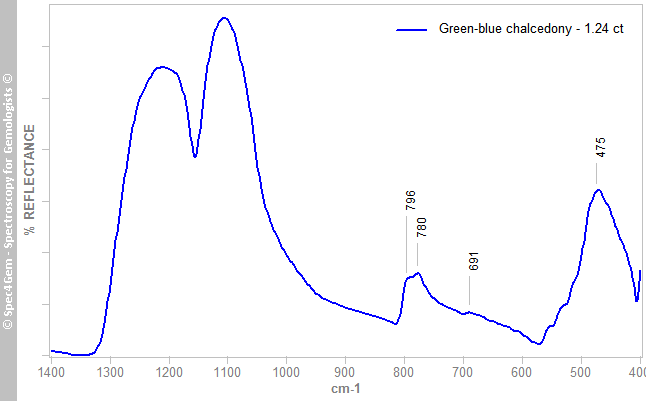 Figure 2. IR reflectance spectrum of the 1.24 ct green-blue gemstone that is a characteristic quartz spectrum and especially chalcedony.
UV-VIS-NIR spectroscopy:
The UV-Vis-NIR spectrum was acquired with the light path crossing from culet to table, anyway since the material is polycrytalline the orientation does not affect the absorption / transmission spectrum. The later (figure 3) shows two main absorption bands at 429 and 606 nm with additional sharp and weak bands at 643, 679 and 927 nm, all are usually attributed to Cr3+[2][9][10]. The transmission window around 500 nm created by the two main band gives the green-blue color to the material. According to published data about gem silica and chalcedony, the later does not owe its color to Cr3+ but to Cu2+ whose spectrum is very distinct from the obtained one[3]. The spectrum can be compared to that of the "gem-silica rough from Ica Mine, Peru". With such a characteristic spectrum, it is obvious the gemstone is a chalcedony colored by chromium most exactly trivalent chromium (Cr3+).
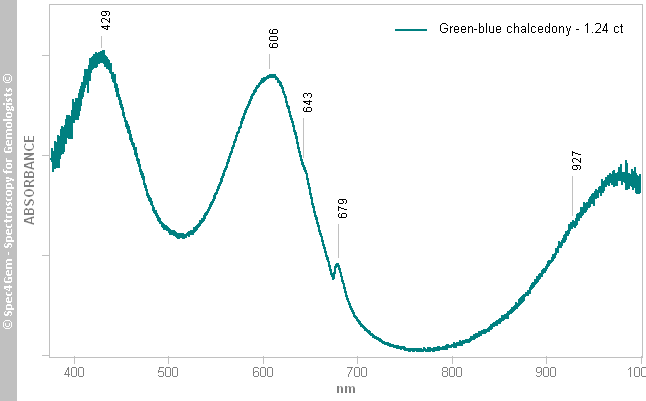 Figure 3. UV-Vis spectrum of the 1.24 ct green-blue gemstone showing two main absorption bands 429 and 606 nm with additional sharp and weak bands at 643, 679 and 927 nm, all usually attributed to Cr3+[2][9][10].
Photoluminescence spectroscopy:
No luminescence observed with the following sources : 254, 280, 365 and 405 nm.
Conclusion:
This 1.24 ct green-blue gemstone is a chalcedony (polycrystalline quartz) colored by Cr3+ that cannot be considered as gem silica. Could this be the "aquaprase" material coming from Africa as described in the 2015 winter edition of the Gems & Gemmology[3] ?
[1] Mineralogical Applications of Crystal Field Theory, R. G. Burns, 2005, ISBN: 0521017858 | 978-0521017855 pp. 235–239 - Andersen (1978)
[2] Natural-Colored Chrome Chalcedony Identified Using Laser Ablation–Inductively Coupled Plasma–Mass Spectrometry (LA-ICP-MS). Andy Shen, GIA Laboratory, Carlsbad
[3] Nathan Renfro, GIA, Carlsbad. A new natural-color bluish green chalcedony. Gems & Gemmology, 2015, Winter, pp. 452–454.
[4] Blue Chrysocolla Chalcedony from Peru. Journal of Gemmology, 2014, volume 34, No.1, pp. 9–10
[5] Chrysocolla Chalcedony from Spain. Journal of Gemmology, 2015, volume 34, No.6, p. 472
[6] Chrysocolla chalcedony from Acari, Peru. Gems & Gemmology, 2010, Summer, pp. 148–149.
[7] Dyed chalcedony resembling chrysocolla. Gems & Gemmology, 2008, Winter, p. 379.
[8] Chrysocolla chalcedony from Iran/Armenia area Gems & Gemmology, 2007, Winter, pp. 376–377.
[9] Dyed blue chalcedony detected by UV-Vis-NIR spectroscopy. Gems & Gemmology, 2007, Fall, pp. 245–246.
[10] Identification of Dyed Chrysocolla Chalcedony. Gems & Gemmology, 2006, Fall, p. 140.
[11] Pink opal from Monte Rosa, Peru. Gems & Gemmology, 2006, Summer, pp. 176–177.
[12] Adularescent chalcedony from Iran. Gems & Gemmology, 2004, Winter, p. 337.
[13] Chrysocolla-colored chalcedony from Mexico. Gems & Gemmology, 1992, Spring, pp. 59–60.