
Vesuvianite, also known as idocrase, is a green, brown, yellow, or blue sorosilicate mineral. Vesuvianite occurs as tetragonal crystals and its chemical formula is Ca10(Mg, Fe)2Al4(SiO4)5(Si2O7)2(OH,F)4. Grossular garnet and vesuvianite can intimately inter-grow, set in diopside-wollastonite-calcite marbles.
Californite is a name sometimes used for jade-like vesuvianite, also known as California jade, American jade or Vesuvianite jade. Californite is a massive vesuvianite-grossular mixture reported first from California and later found in various other localities, such as Africa and Pakistan.
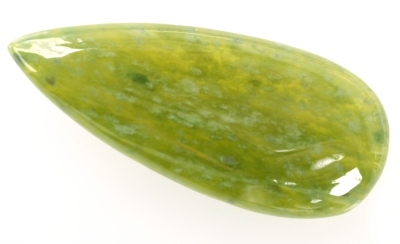 Figure 1. The 32.38 ct pear shaped cab of vesuvianite.
| Shape | pear shaped cab |
| Size | 40.6 x 17.5 x 4.6 mm |
| Color | dark olive green (brownish green) |
| Lustre | vitreous |
| Weight | 32.38 ct |
| SG | 3.32 |
| RI | - |
| DR | - |
| Pleochroism | - |
| Polariscope / Conoscope | stays light through 360° -> polycrystalline |
| SWUV | inert |
| LWUV | inert |
| Magnetic susceptibility | N52 drags almost 7% of total weight |
Table 1. Observational and measured properties
Infrared reflectance spectroscopy:
 Figure 2. IR reflectance spectrum of the top the 32.38 ct olive green vesuvianite cab. It shows a silicate pattern and it is consistent with vesuvianite spectra.
 Three spectra were acquired, all giving the same pattern as shown in figure 2. The spectrum is consistent with those of other vesuvianite in the database. It was also compared to the averaged spectrum obtained from the Caltech database [1] spectra (vesuvianite (001) & vesuvianite (010)) and the comparison gives also an almost perfect match.
The spectrum does not show any grossular garnet band, at least from the surface of the cab's top. This does mean there is no grossular mixed with vesuvianite in the cab, the spectrum just describes the reflectance of the surface, so it cannot be used to detect materials in the depth of the sample.
UV-VIS-NIR spectroscopy:
 Figure 3. UV-Vis-NIR absorption spectrum of the 32.38 ct olive green vesuvianite cab showing Fe3+ absorption bands.
 The UV-Vis-NIR spectrum of the 32.38 ct cab (figure 3) was acquired with a light path from the cab's top to the cab's back where the cab was transparent. There is a strong absorption in the UV and violet range, accompanied by few distinct features, a narrow band at 462nm, a band at 530 nm followed by a (or several bands) wide band around 620nm. There is an additional band around 940 nm. Note that the spectrum is a 'mean' spectrum that is not affected by polarization since it is obtained from a polycrystalline sample (except if all crystals are oriented in the same direction). According to Caltech database [2] source, such a spectrum is the result of Fe3+. Some deconvolution experiments give some bands at 465, 530, 590 and 650 nm thus 21500, 18870, 16950, 16130 cm-1 respectively but those bands do not match those given in Burns [3] for Fe3+ in vesuvianite. Note also the 940 nm band is not seen in all Fe3+ vesuviante.
UV-Vis Caltech database [2] spectra are mostly polarized spectra, to compare them to the spectrum of the sample, polarized spectra of a given vesuvianite sample of the Caltech database [2] are simply averaged together with an arithmetic mean and then corrected to get a similar absorption levels. The closest match is that of the vesuvianite 1901 sample supposedly from Bisel, Kenya, that also shows the 940 nm band (figure 4).
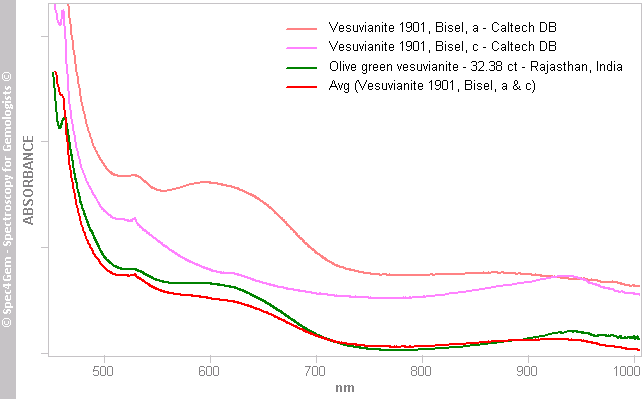 Figure 4. UV-Vis-NIR absorption spectrum of the 32.38 ct olive green vesuvianite cab versus vesuvianite 1901 (Bisel, Kenya) from Caltech DB.
Photoluminescence spectroscopy:
No luminescence observed with 405, 365, 275 nm excitation sources.
Conclusion:
The sample is a 32.38 ct olive green vesuvianite cab owing its color to the Fe3+ transition metal ion. Vesuvianite is detected from the surface and it does mean that grossular is not inter-grown. Classical gemological properties are consistent with vesuvianite.
[1] Caltech - List of Infrared Reflectance Files
[2] Caltech - Vesuvianite Visible Spectra (380 - 1100 nm)
[3] Mineralogical Applications of Crystal Field Theory, R. G. Burns, 2005, ISBN: 0521017858 | 978-0521017855