
This large (38 x 25 mm) serpentine cab weighing 42.80 ct (figure 1) donated by Gems-Plus shows an uniform pale yellow color (milky yellow), luster is vitreous. All the cab's material is homogeneous. Origin is unknown.
The serpentine 'group' describes a group of common rock-forming hydrous magnesium iron phyllosilicate (Mg,Fe)3Si2O5(OH)4 minerals; they may contain minor amounts of other elements including chromium, manganese, cobalt or nickel. They form in metamorphic alterations of peridotite and pyroxene. All are microcrystalline and massive in habit, never being found as single crystals. Many are inter-grown with other minerals, such as calcite and dolomite.
The term serpentine will be used in this note to refer to one or several of the polymorph unless explicitly noted.
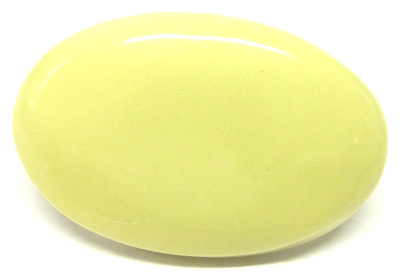 Figure 1. The 42.80 ct serpentine cab shows an unusual pale yellow color.
| Shape | oval cab |
| Size | 38 x 25 x 5.6 mm |
| Color | pale yellow |
| Lustre | vitreous |
| Weight | 42.80 |
| SG | 2.55 |
| RI | ~1.53 |
| DR | - |
| Pleochroism | - |
| Polariscope / Conoscope | - |
| SWUV | inert |
| LWUV | inert |
| Magnetic susceptibility | very very weak, N52 magnet drags only 0.4% of the total weight |
Table 1. Observational and measured properties
Infrared reflectance spectroscopy:
The cab's size being quite large, setting it in the reflectance accessory required a handmade device to acquire the spectrum from the cab's top.
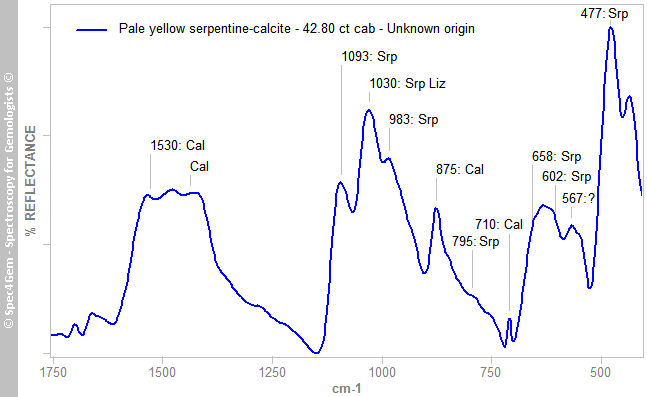
Figure 2. IR reflectance spectrum from the top of the cab shows serpentine and calcite spectrum, the large reflection band set from 1200 to 1600 cm-1 being characteristic of carbonates (CO32-). The bands are annotated with the following keys: Srp = serpentine, Srp Liz = Lizardite, Cal = calcite. The 1030 cm-1 band is characteristic of lizardite, one of the serpentine polymorphs.
The IR reflectance spectrum of the cab's top (figure 2) reveals the reflection bands of serpentine at 477, 602, 652, 983, 1030 and 1093 cm-1 but also the reflection bands of a carbonate mineral, specifically calcite with the reflection bands at 710, 875, ~1400, 1530 cm-1. Note the 1030 cm-1 band is characteristic of the lizardite, one of serpentine polymorphs with antigorite and chrysotile. The band does have any shoulder circa 1050 cm-1, the characteristic band of antigorite, therefore the serpentine cab's material is mostly lizardite.
This cab shows some likeness with the cab described in the following report: 'Calcite with serpentine reportedly from China'.
UV-VIS-NIR spectroscopy:
The cab having a thickness of about 5 mm and being almost opaque, the absorption spectrum is acquired from the cab's border where thickness is less and the material becomes translucent. Even with that and because of the limits of the instruments and the strong absorption of some serpentine within the 300 - 500 nm range, it is impossible with the current configuration to get the spectrum for that spectrum range. The acquired spectrum is shown in figure 3 and the band assignments are summarized in table 2.
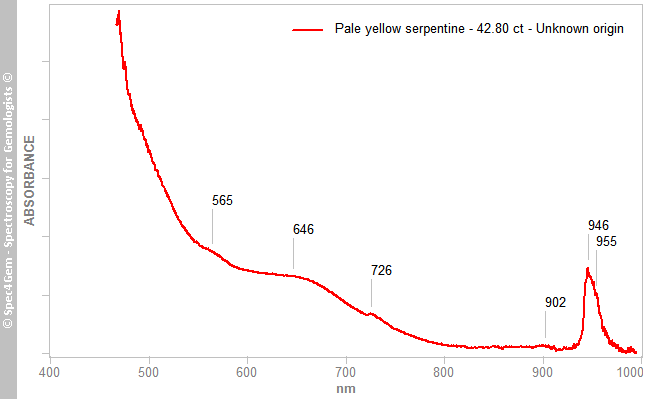 Figure 3. UV-Vis-NIR absorption spectrum acquired from the cab's border. The spectrum is similar to that of other serpentine, lizardite and antigorite. There is a strong absorption continuum from the red to UV where are overlapped four weak absorption bands at 565, 646, 726, 902 nm and a strong doublet at 946 and 955 nm. The doublet is unusually strong compared to other serpentine samples studied up to now.
The spectrum is consistent with the spectra of other lizardite and it does not seem to be affected by the presence of calcite in the material since it is very similar to spectra of lizardite where calcite is not detected by IR reflectance spectroscopy. The band assignment is not clear at the moment, few transition metal such as Cr, Ni, Mn, Fe and Co can replace Mg sites. There is usually some features between 400 and 475 nm attributed to Mn2+ (Rodriguez et al., 1993) and Fe3+ (Marfunin, 1979), but those features cannot be observed here because of the opacity of the material and the thickness of the light path. There is a strong absorption continuum starting from the red to the UV where are overlapped four weak absorption bands at 565, 646, 726, 902 nm and a strong doublet at 946 and 955 nm. The doublet is unusually strong compared to other serpentine samples studied up to now. The 910 nm Fe2+ band is almost inexisting as well as the 1000 nm Ni2+ band, therefore it is difficult to state on the band assignments.
| Band (nm) | Cause | References |
| Vis to UV continuum | O2- -> Fe2+ Charge Transfer | [1] |
| 565 | unexplained, possibly Fe2+ or Mn2+ ??? | |
| 646 | Ni2+, Fe2+ : but nor the 910 nm Fe2+ band nor the Ni2+ band around 1000 nm do exist, so it is impossible to state. | [1] |
| 726 | possibly Ni2+, Fe2+ but nor the 910 nm Fe2+ band nor the Ni2+ band around 1000 nm do exist, so it is impossible to state. | [1] |
| 902 | usually Fe2+ but disappears if Fe content falls under 2% | [1] |
| 946 & 955 | absorption doublet,here unusually strong, unexplained |
Table 2. Absorption band assignments.
Photoluminescence spectroscopy:
The cab's material being almost opaque, the luminescence is only observed around the 405 nm laser spot. SWUV and LWUV lamps do not excite any luminescence. The observed luminescence color is 'cream', greenish white, the spectrum is shown in figure 4 and it consists of a large emission peak centered at 537 nm with a FWHM of about 125 nm and two additional peak shoulder at 490 and 590 nm. The emission ranging from 460 nm to beyond to 700 nm, results in the 'cream' color.
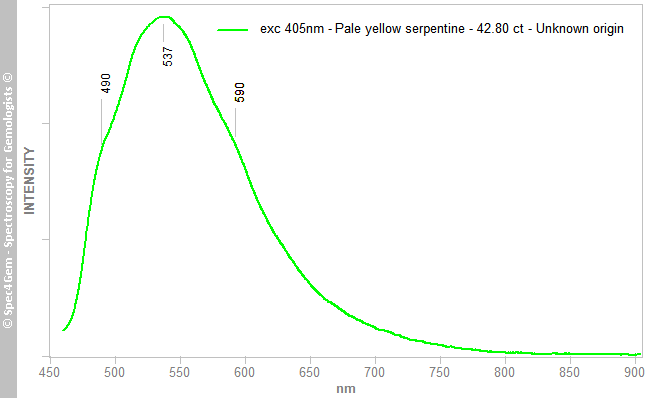 Figure 4. 405 nm excitation photoluminescence spectrum showing a large emission peak centered at 537 nm with a FWHM of about 125 nm.
Serpentine is not known to be a luminescent mineral, is the observed phenomenon luminescence or the result of light scattering or anything else? An another important point should be considered since the cab is composed of lizardite but also calcite.
A very similar spectrum was observed in a translucent adamite from China which is attributed to uranyl ion UO22+, could this be the case here? Calcite is known to show some green luminescence caused by UO22+, Gorobets and Rogojine [2].
Conclusion:
This unusual pale yellow cab is composed of lizardite (serpentine) intergrown with calcite.