
Copper-bearing “Paraíba tourmaline,” a geochemical oddity, was discovered in Brazil in 1988. Its rich and unique colors have given it extraordinary gemstone value, resulting in the preservation of very few good crystal specimens. Renewed exploration and mining were initiated in 1999. The tourmaline group consists of 13 species, elbaite, liddicoatite and uvite being among the most colorful. Until the discovery of the Batalha occurrence in the state of Paraíba, northeastern Brazil, none were known to be colored by copper. The extraordinary colors of the cuprian elbaite from the Batalha pegmatite veins, results from the presence of copper (and, to a lesser extent, manganese), especially an incredibly bright and rich turquoise-blue, are the reason for its fame and popularity. Since then, cuprian elbaite is found in Mozambique.
The stone described in this report ((figure 1), is an old stone set on a ring and recently re-cut. The color is exactly not that of the cuprian elbaite but it is still interesting to know if this tourmaline is a copper bearing tourmaline or not.
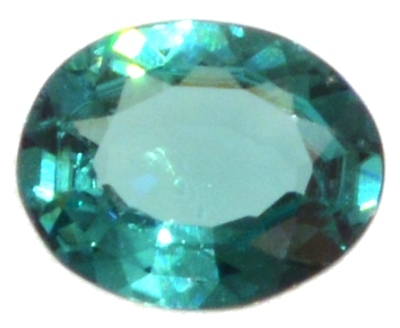 Figure 1. Vivid-blue tourmaline - 1.21 ct - (Brazil)
| Shape | oval |
| Size | 8.4 x 6.7 x 3.2 mm |
| Color | very strongly greenish-blue |
| Lustre | vitreous |
| Weight | 1.21 ct |
| SG | 3.18 |
| RI | 1.619 - 1.640 |
| DR | 0.021 |
| Pleochroism | very strongly greenish-blue / grayish green-blue |
| Polariscope / Conoscope | uniaxial cross is visible through table which is cut perpendicular to crystal axis |
| SWUV | inert |
| LWUV | inert |
| Magnetic susceptibility | very weak drag |
Table 1. Observational and measured properties
UV-VIS-NIR spectroscopy:
Answering about the question to know whether this tourmaline is a Paraiba type tourmaline or not is quite simple since a simple UV-Vis-NIR spectroscopy can be sufficient in most cases to diagnostic the presence of copper in the crystal structure influencing the gem's color.
There is no need to acquire polarized spectra of the uniaxial tourmaline, ordinary and extra-ordinary rays are very similar. The spectrum (figure 2, blue color) was acquired with the light path perpendicular to the table, entering by the culet and exiting from the table.
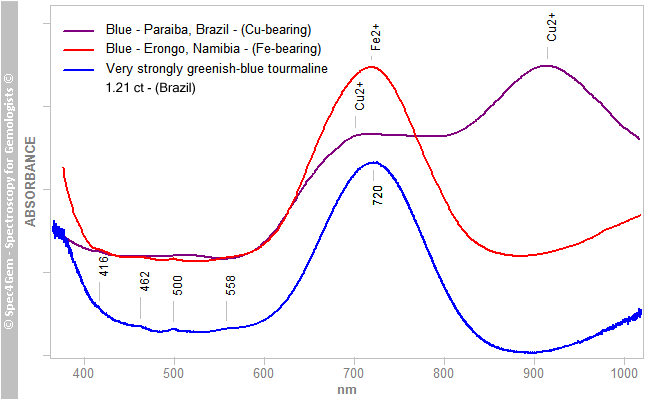 Figure 2. The 1.21 ct tourmaline UV-Vis-NIR spectrum (in blue) is compared to a Fe-bearing tourmaline spectrum and to a Cu-bearing tourmaline spectrum blue spectrum (all spectra are normalized and shifted for better clarity).
| Band (nm) | Cause | References |
| 416 | Mn2+ | [7] |
| 462 | ? (often observed in many Fe-bearing tourmaline) | |
| 500 | Fe2+ | [2] |
| 558 | Mn3+ (may disappear after heating to 550°C) | [7] |
| 720 | Fe2+ (cannot be Cu2+ since there is no absorption in the vicinity of 900 nm) | [1],[2],[3],[4],[5],[6] |
| > 1000 | a large absorption band attributed to Fe2+ | [1] |
Table 2. Absorption features with their attributions
The spectrum (figure 2, blue color) clearly shows a strong absorption centered around 720 nm, followed by a zone without any absorption in the 900 nm neighbourhood and another large absorption near 1060 nm. This particular absorption pattern is ascribed to the Fe2+ ion replacing the Al and Mg ions in their respective sites. Even if the strong band in the 700 nm can be confused with that of Cu2+ ion, the Cu2+ absorption pattern significantly differs from that of Fe2+ because Cu2+ shows a strong absorption in the 900 nm although Fe2+ does not. The figure 2 additionally shows the spectra of a blue elbaite tourmaline from Erongo, Namibia which is a Fe-bearing elbaite and one of a blue elbaite tourmaline from San José, Paraiba, Brazil which is a Cu-bearing elbaite, the comparison is trivial.
Photoluminescence spectroscopy:
No observed photoluminescence with 254 and 405 nm excitation.
Conclusion:
All classical gemological properties are consistent with tourmaline data. The UV-Vis-NIR spectroscopy leads to the conclusion that tourmaline is an iron-bearing tourmaline and not a copper-bearing one, therefore it cannot be attributed the Paraiba type.
[1] Mineralogical Applications of Crystal Field Theory, R. G. Burns, 2005, ISBN: 0521017858 | 978-0521017855.
[2] Gem-quality cuprian-elbaite tourmalines from São José da Batalha, Paraíba, Brazil. Fritsch E., Shigley J.E., Rossman G.R., Mercer M.E., Muhlmeister S.M., Moon M. (1990), G&G Vol. 26, No. 3, pp. 189–205.
[3] Copper-bearing (Paraíba-type) tourmaline from Mozambique, Laurs B.M., Zwaan J.C., Breeding C.M., Simmons W.B., Beaton D., Rijsdijk K.F., Befi R., Falster A.U. (2008), G&G, Vol. 44, No. 1, pp. 4–30.
[4] Origin of color in cuprian elbaite from São José da Batalha, Paraíba, Brazil, Rossman G.R., Fritsch E., Shigley J.E. (1991), American Mineralogist, Vol. 76, pp. 1479–1484.
[5] Spectral differentiation between copper and iron colorants in gems tourmalines, Paul B. Merkel and Christopher M. Breeding, G&G, Vol. 45, No. 2, pp. 112–119.
[6] The polarized optical absorption spectra of tourmaline, cordierite, chloritoid and vivianite: Ferrous-ferric electronic interaction as a source of pleochroism, Faye G.H., Manning P.G., Nickel E.H. (1968), American Mineralogist, Vol. 53, pp. 1174–1201.
[7] Yellow, Mn-rich elbaite with Mn-Ti intervalence charge transfer, Rossman G.R., Mattson S.M. (1986), American Mineralogist, Vol. 71, pp. 599–602.