
The 3.54 ct gemstone described in this work was studied along with two other gemstones with fully identical properties and spectra, they were just smaller with a weight of 2.06 and 1.52 ct. They all came from distinct providers and two were sold as edenite and one as pargasite from Myanmar. The gemstones are very-light-yellow in color and transparent with few inclusions, see figure 1. Edenite and pargasite are calcic amphibole species on the magnesio end with the ideal chemical formula respectively: NaCa2Mg5Si7AlO22(OH)2 and NaCa2Mg4AlSi6Al2O22(OH)2. Edenite and pargasite amphiboles have some neighbours in the amphibole classification space such as the magnesio-hornblende, magnesio-hastingsite, tremolite / actinolite in the calcic group and the richterite in the sodic-calcic group. Some more amphibole members do exist but they have not really been marketed as gemstone yet.
Note the interesting fact: this complex silicate has seven (eight with K) of the 'big 8' elements (O,Si,Al,Fe,Ca,Na,K,Mg) in the Earth's crust in one mineral!
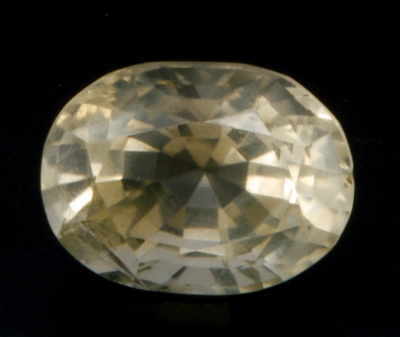 Figure 1. The 3.54 ct very-light-yellow edenite, a calcic amphibole
from Myanmar.
The Magnesium (Mg) can partially or totally be replaced by Fe2+ by homovalent substitution to give another end-member respectively named ferro-edenite, ferro-pargasite, and so on. These ferro-species form series with their respective species as the Mg/Fe ratio changes. Other substitutions can occur such as potassium (K) that can partially replace Na in the first site and fluor (F) that can partially replace OH, if the latter are the major contributor in their respective sites, then the amphibole can be prefixed with potassic- and/or fluoro-.
After the IMA1997 (International Mineralogical Association) report [4] [5], edenite and pargasite species determination keys are defined by:
Na[0.5-1] and (Ca[1.5-2]Na[0-0.5])Σ=2 and Ti<0.5 and
- Si[6.5-7.5[ for edenite
- Si[5.5-6.5[ for pargasite.
Once the Na,Ca classification done, the silicium (Si) is the main key for classifying amphiboles.
As of 2006, Hawthorne and Oberti [6] [7] have proposed to enhance the amphiboles classification with the significant change that Si content is no longer used, instead the Al,Fe3+,Mn,Ti and some less frequent cations occupying the 'C-group' will be used. At the same time, it was proposed to reduce the rootnames (edenite, pargasite, richterite, tschermakite, ...) and two proposals were suggested, respectively named scheme 1 and scheme 2. In the scheme 2 model, pargasite is discarded and its corresponding space is then evenly shared between edenite and sadanagaite while in the scheme 1, pargasite remains only as an intermediate member between the formal end-members edenite and sadanagaite. At the time of writting, the IMA has not stated yet about all of these changes.
| Shape | deep oval mixed-cut |
| Size | 10.8 x 8.0 x 6.5 mm |
| Color | very-light-yellow |
| Lustre | vitrteous |
| Weight | 3.54 |
| SG | 3.08 [Eden: 3.01-3.30, Par: 3.03-3.19, Horn: 3.10-3.30, Trem: 2.94-3.15, Rich: 2.86-3.46] |
| RI | 1.617 - 1.640 [Eden: 1.605-1.685, Par: 1.612-1.671, Horn: 1.615-1.725, Trem: 1.600-1.637, Rich: 1.602-1.642] |
| DR | 0.023 B+ [Eden: 0.018-0.025 B+/-, Par: 0.018-0.024 B+/-, Horn: 0.014-0.022 B-, Trem: 0.024-0.029 B-, Rich: 0.016-0.024 B-] |
| Pleochroism | none or too weak to be observed |
| Polariscope / Conoscope | anisotropic: light/dark 4 times / 360°, impossible to locate the interference figures |
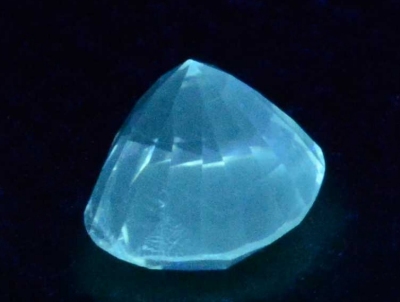
| SWUV | strong greenish-blue luminescence (see figure 2) |
| LWUV | almost inert |
| Magnetic susceptibility N52 | inert |
| Chelsea filter | inert |
Table 1. Observational and measured properties
Amphiboles' names are abbreviated as follows: Edenite, Pargasite, Magnesio-Hornblende, Tremolite, Richterite.
Identifying amphiboles to put them in their classification boxes is always a challenge, see the litterature [1] [2] [3] [4] [5] [6] [7]. Classical gemology is almost useless if RI, DR, optical character and sign, SG are used as is, because of the overlapping of all these properties. However the data from a given specie of a given locality can be reliable enough for identification of known materials. The low RI and SG are consistent with edenite and pargasite, ferro- edenite/pargasite would have higher RI.
As the pargasite could contain more Fe3+, Mn2+, Cr3+ ions than edenite, its magnetic susceptibility would be higher than that of edenite. The gemstone is inert while subjected to the N52 magnet test.
The most reliable is the chemical composition analysis but this is sometime destructive. IR and raman spectroscopy can really help at least to distinguish the species.
In july 2008, J-C Bouilliard and D. Gravier [8] published a study about a 22.7 ct light-yellow edenite from Myanmar that revealed to be a fluoro-richterite as far as the powder used for the θ-θ X-Ray diffractometer came from the same bloc of rough the facetted gemstone was cut from. Such analysis provides the dimensions and angles about the cell.
From that, there is a room for doubt concerning the edenite identification of the present work!
Infrared reflectance spectroscopy:
The infrared reflectance spectra were collected from five distinct directions (one from the table facet and four from the pavilion facets). Two of the most representative spectra were selected and they are shown in figure 3. Anisotropy of the material leads to variations in spectra. The spectra unambigously identify amphibole, the features' patterns in the 600-800 cm-1 range, along other bands positions are consistent with edenite and pargasite spectra. The characteristic richterite bands, at 670 cm-1 and the prominent 741 cm-1 one are not present in the spectra, richterite is thus 'excluded'. The spectra pattern differ also of that of tremolite/actinolite. These statements are based on my personnal observations which of course do not rely on thousands of samples, but they are also consistent with the data published in RRUFF database either as IR-ATR and raman spectra.
The classification of amphibole is not that complicated but as all the variables of the chemical composition can vary at the same time, this leads to multiple solid solution series and it is often common to find several amphiboles species intergrown making idendification sometime unreliable.
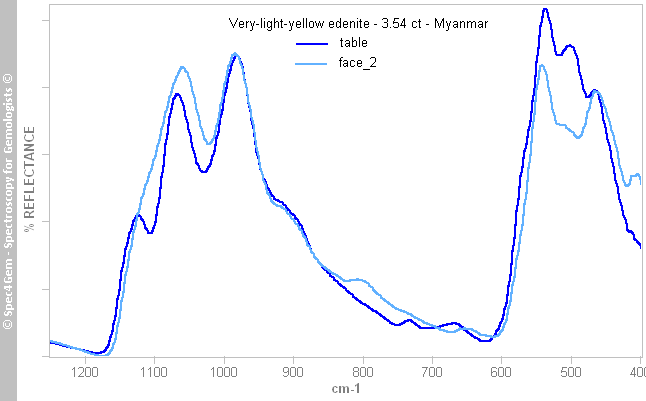 Figure 3. The infrared reflectance spectra unambigously identify amphibole, the features' patterns in the 600-800 cm-1 range along other bands positions are more consistent with other edenite's spectra than with pargasite's spectra.
UV-VIS-NIR spectroscopy:
The UV-Vis-NIR spectrum (figure 4) of this amphibole was collected with the light path perpendicular to the gemstone table. The spectrum consists in an absorption continuum towards the UV, starting around 800 nm and showing a strong egde around 390 nm. Weak features are observed at 428 and 438 nm, a larger weak band is centered around 655 nm and a stronger band around 1000 nm is along with a weak feature at 940 nm.
The absorption continuum is likely to be caused by iron, the 1000 nm band is attributed to Fe2+ while the 665 nm is related to Fe2+-Fe3+ IVCT. The features at 428 and 438 nm are also possibly connected to Fe3+ iron. The weak band at 940 nm is prossibly related to OH/water overtones.
The presence of Fe2+ and Fe3+ indicates the gemstone is not a pure edenite end-member, so it is still consistent with edenite and ferro-edenite. The traces of Fe3+ tends to indicates the material is located somewhere between edenite/ferro-edenite and pargasite/ferro-pargasite (respectively magnesio-hastingsite/hastingsite if Fe3+ > Al, this is unlikely the case here). In comparison to the brown pargasite from Tanzania, the 665 nm large band is much weaker here, Fe3+ is present but not as much to shift this gemstone in the pargasite end.
This gemstone owes its very-light-color to iron.
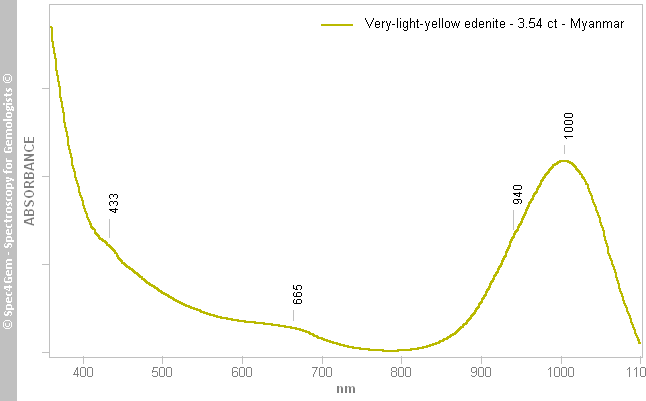 Figure 4. The unpolarized UV-Vis-NIR absorpion spectrum of the 3.54 ct edenite shows a large absorption continuum from 800nm towards the UV, likely caused by iron, two weak features at 428 and 438 nm likely related to Fe3+, a large but quite weak band centered around 665 nm related to Fe2+-Fe3+ IVCT and a quite strong band at 1000 nm attributed to Fe2+. The weak band at 940 nm is possibly related to OH/water overtones.
Photoluminescence spectroscopy:
The photoluminescence of this gemstone sample was collected with two excitation sources, 254 nm and 405 nm. The related spectra (figure 5) show respectively a strong greenish-blue emission peaking at 500 nm for the 254 nm excitation and a much weaker yelow/orange emission peaking around 590 nm for the 405 nm excitation.
The 500 nm emission is possibly attributed to O* similarly to what is observed in richterite after Gorobets & Rogojine[9] while the 590 nm one is attributed to Mn2+ which is commonly observed in amphiboles. The Mn2+ emission at 590 nm is not observed as a separate peak in the 254 nm excitation spectrum but it could be present and could partly explain the asymetry of the 500 nm emission even if such kind of feature can be caused by other phenomenoms.
Fluoro-richterite from Afghanistan shows a distinct luminescence under the SWUV lamp, the emission color is a chalky yellow-orange. In fact it shows the 580 nm peak attributed to Mn2+ and a very large and weak band around 520 nm that likely gives chalky color.
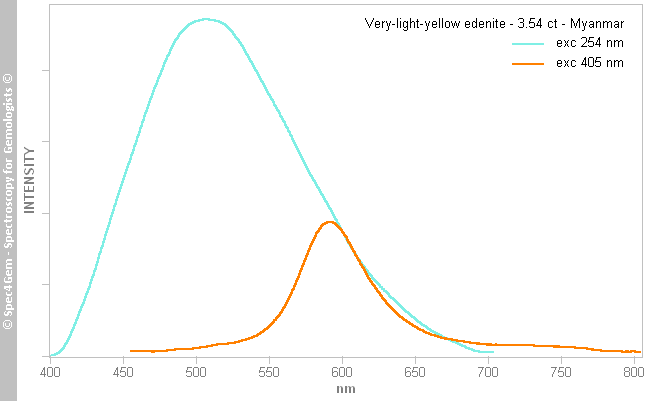 Figure 5. The 3.54 ct edenite's photoluminescence spectra recorded with the two excitation source, 254 and 405 nm, show respectively a strong greenish-blue emission peaking at 500 nm and a much weaker yelow/orange emission peaking around 590 nm. The 500 nm emission is possibly attributed to O* while the 590 nm one is attributed to Mn2+.
A 635 nm excitation source was used to try to get Fe3+ luminescence but this experiment was unsuccessful.
Conclusion:
Classic gemology results are consistent with edenite/pargasite. IR reflectance spectra are consistent with that of edenite/pargasite and exclude tremolite/actinolite as well as richterite. UV-Vis-NIR spectroscopy shows the presence of Fe2+ and in a less extend Fe3+, this is consistent with edenite/pargasite as well. Photoluminescence spectroscopy shows the presence of Mn2+ but not that of Fe3+.
In comparison with other IR spectra of my other amphiboles I would preferably put this amphibole in the edenite end especially if pagasite could disappear the day the IMA will approve the scheme 2 proposed by Hawthorne and Oberti [6] [7] or because the scheme 1 will be adopted relaying pargasite as an intermediate member. Anyway, without a chemical analysis or any publication realted to similar material it is almost impossible to definitely conclude.
2012, the International Mineralogical Association published its IMA2012 report [10] based on Hawthorne and Oberti proposals [6] [7] approving the classification based on Al, Fe3+, Mn2+, ... cations instead of Si content. The naming scheme 1 was chosen, pargasite is still a valid name but only as an intermediate member.
2016, following the publication in 2015 by Heaveysege, Abdu and Hawthorne in the Canadian Mineralogist [11], the sample used in the study amazingly looks like the stone of this work and comes from the same locality. Even if it is not possible to definitely be sure it is exactly the same material, the chances are hight. Anayway it is worth to consider it. The material is described as having a composition close to edenite50-pargasite50. The chemical analysis lead to the following formula:
(Na0.93K0.09)(Ca1.78Na0.15)Mg4.51Fe2+0.02Al0.53Ti0.01Si6.56Al1.44O22(OH1.32,F0.68)2
(Na0.94K0.09)(Ca1.78Na0.15)Mg4.44Al0.53Fe3+0.02Ti0.01Si6.55Al1.45O22(OH1.32,F0.68)2 if recalculated with IMA2012 method from oxides wt%
- According to IMA1997: this is an edenite because of its Si content, 6.56 is in the edenite range of 6.50-7.50
- According to IMA2012: this is a pargasite because of the Al, Ti cations, 0.53+2*0.01=0.55 or 0.53+0.02+2*0.01=0.57 both are >0.50
[1] Further studies in the amphibole group - A.N. Winchell - American Mineralogist, Vol. 16, p. 257
[2] Variations in composition and properties of the calciferous amphiboles - A.N. Winchell - American Mineralogist, Vol. 30, p. 27
[3] Amphibole group - Rock-forming Minerals: Double-Chain Silicates, Vol. 2B p. 412 - William Alexander Deer, Robert Andrew Howie, J. Zussman
[4] Nomenclature of Amphiboles: Report of the Subcommittee on Amphiboles of IMA - B.E. Leake & Al, Mineralogical Magazine, Vol. 61, p. 295, April 1997
[5] Nomenclature of amphiboles: Additions and revisions - B.E. Leake & Al, American Mineralogist, Vol. 89, p. 883, 2004
[6] On the classification of amphiboles, F C. Hawthorne, Roberta Oberti, The Canadian Mineralogist, Vol. 44, pp. 1-21, 2006
[7] Classification of the Amphiboles, F C. Hawthorne, Roberta Oberti, Reviews in Mineralogy & Geochemistry, Vol. 67, pp. 55-88, 2007
[8] Une amphibole gemme du Myanmar, J-C Boulliard, D. Gravier, Revue de Gemmologie A.F.G., N°164, Juillet 2008, pp. 4-5
[9] Luminescent Spectra of Minerals, Boris S. Gorobets and Alexandre A. Rogojine, Moscow, 2002, ISBN: 5901837053
[10] Nomenclature of the amphibole supergroup: IMA Report, F C. Hawthorne, Roberta Oberti, et al, American Mineralogist, Vol. 97, pp. 2031–2048, 2012
[11] Long-range and short-range order in gem pargasite from Myanmar, Heaveysege, Abdu and Hawthorne, The Canadian Mineralogist, Vol. 53, pp. 497-510, 2015