
Brucite is mainly a collector's mineral composed of magnesium hydroxide. It occurs in various colors as white, gray, grayish-blue, light-green and more recently as deep yellow (lemon-yellow). Around 2015, maybe earlier, a new find in southern Pakistan, in the Killa Saifullah District, brought to the market brucite specimens with an amazing saturated lemon color. In fact, colors from this area varie from light-yellow to deep-yellow to honey-brown. The best colors have immediately become a reference for mineral's collectors, a stunner.
The brucite material is quite soft with the hardness of 2.5 to 3 on Mohs scale, ruling it out of being used as a gemstone, despite that some pieces have been facetted for gems' collectors. The sample (figure 1) described in this report gives a good overview of what kind of gemstone one can expect from brucite material. Better gem quality might be expected soon, but just keep in mind it is not intended for jewelery because of its softness.
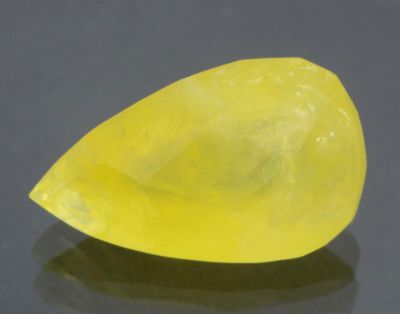 Figure 1. 2.26 ct lemon-yellow brucite gemstone from Killa Saifullah
District, Balochistan, Pakistan.
| Shape | pear |
| Size |
12.3 x 7.4 x 5.3 mm |
| Color | yellow (lemon-yellow) |
| Lustre | waxy, dull |
| Weight | 2.26 ct |
| SG | 2.35 |
| RI | cannot be read: the 'poor' facet polishing does not meet the quality required for the refractometer reading, hardness is only 2.5 to 3. |
| DR | - |
| Pleochroism | - |
| Polariscope / Conoscope | stays light through 360° like polycrystalline stones, it is likely cut from an aggregate of crystals |
| SWUV | inert |
| LWUV | inert |
| Magnetic susceptibility N52 | diamagnetic |
| Chelsea filter | same color as without filter |
Table 1. Observational and measured properties
Infrared reflectance spectroscopy:
The IR reflectance spectrum was collected from the gemstone's table and is shown in figure 2. The brucite (magnesium hydroxide) has a quite simple spectrum pattern on the mid-IR range (400 - 2000 cm-1). The bands at 487 and 560 cm-1 are expected to be Mg-O stretching and the 695-725 cm-1 bands possibly related to Mg-OH bending, unfortunately it is not so simple but it is enough for an introduction to the vibrationnal spectroscopy! The water band around 1600 cm-1 is not observed.
Some more spectra were collected from rough samples from the same location, all gave the same spectrum pattern.
Brucite's ATR spectra can be found in RRUF database [1], even if spectroscopy methods differs, spectra are comparable. This is the same with the transmission spectra of several brucite described in the Chukanov's 'Infrared spectra of mineral species' book [2].
 Figure 2. IR reflectance spectrum of the brucite from Killa Saifullah District, Balochistan, Pakistan. The bands at 487 and 560 cm-1 are expected to be Mg-O translation mode and the 695-725 cm-1 bands possibly related to Mg-OH bending.
 UV-VIS-NIR spectroscopy:
The unpolarized UV-Vis-NIR spectrum shown in figure 3, is characterized by strong absorption edge between 400 and 500 nm. The remaining part of the spectrum in the visible range does not exhibit any absorption. In the NIR range, few weak and narrow absorptions can be observed at 735, 925 and 956 nm. The 956 nm one is likely the result of water overtones, regarding the other ones, possibly related to Fe2+, Ni2+ but this is just a working hypothesis.
The cut-off / absorption edge below 500 nm causes the yellow color of the gemstone, pure brucite is colorless, and the real color cause is not known at the moment but likely related to impurities of defects.
Similar spectrum can be found in the Calctech database [3].
 Figure 3. The unpolarized UV-Vis-NIR spectrum is characterized by strong absorption edge between 400 and 500 nm that causes the yellow color of this brucite from Killa Saifullah District, Balochistan, Pakistan.
Photoluminescence spectroscopy:
No photoluminescence with the following sources: 254, 280, 375, 405 and 532 nm.
Conclusion:
All data and spectra are consistent with brucite.
[2] Infrared spectra of mineral species, Nikita V. Chukanov, 2014, Springer, ISBN: 978-94-007-7128-4
[3] Brucite Visible Spectra - List of Visible Data Files on the Caltech Mineral Spectroscopy Server