
Here are four faceted greenish-blue grandidierites from Tulear (Toliara) area, southern Madagascar. They are facetted but this is a semi-transparent quality just fine for cabs. The material is full of veils, cracks a other minor inclusions. Anyway, it is much better than the massive grandidierite examined in 2014 (see massive grandidierite (2014)).
Gem-quality (clean) grandidierite has just been reported in the Gems & Gemology[5] and in the Journal of Gemmology[6], respectively the stones were from a trip to Madagascar and seen at Tucson 2016 show. As written by the authors, mining continues and we might expect more gem-quality stones in a near feature.
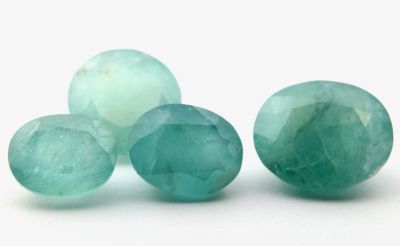 Figure 1. The faceted greenish-blue grandidierite from Tulear Province,
Madagascar show a slight variation in color. From left to right, first
row: 3.79, 4.69 and 7.93 ct, last row: 6.16 ct.
| Shape | oval |
| Size | 10.3 x 8.3 x 6.3 mm |
| Color | greenish-blue |
| Lustre | vitreous |
| Weight | 3.79 ct |
| SG | 2.92 (all samples fall in the range 2.92 ± 0.01) [2.85-3.00[3], 2.92[5], ?[6]] |
| RI | 1.580 - 1.621 [1.590-1.639[3], 1.579-1.620[5], ?[6]] |
| DR | 0.041 B- [0.037-0.039[3], 0.041[5], ?[6]] |
| Pleochroism | grayish greenish-blue / greenish-blue |
| Polariscope / Conoscope | material is translucent, some strain figures |
| SWUV | inert |
| LWUV | inert |
| Magnetic susceptibility N52 | inert |
| Chelsea filter | inert (greenish-blue) |
Table 1. Observational and measured properties (3.79 ct sample)
Infrared reflectance spectroscopy:
The infrared reflectance spectrum (figure 2) of the 3.79 ct grandidierite sample was acquired from its table. It is very similar to that of the massive grandidierite studied in the massive grandidierite (2014) report. It differs in the 800-1200 cm-1 region but this is likely related to the acquiring plane's orientations, the material being anisotropic (orthorhombic).
The spectra of the other samples (4.69, 6.16 and 7.93 ct) are availbale in the database at Grandidierite - IR Reflectance spectra.
 Figure 2. IR reflectance spectrum acquired from the table of the 3.79 ct grandidierite sample that shows the complex structure of grandidierite. Compared to the massive grandidierite (2014) spectrum, the bands in the 800-1200 cm-1 region depend on crystal orientations.
UV-VIS-NIR spectroscopy:
The UV-Vis-NIR spectrum was acquired with the light path perpendicular to the table. The spectrum displayed in the figure 3 shows a transmission window centered at around 500 nm bounded by rather strong absorption in UV and red and NIR. The features at 388, 444 and 460 nm in UV and blue and the strong and large hump at 750 nm followed by a stronger band above 900 suggests the color is likely caused by the Fe2/3+. The spectrum is identical to that of massive grandidierite (2014).
All four stones show identical absorption, the other spectra are available in the database at Grandidierite - UV-Vis spectra.
 Figure 3. The UV-Vis-NIR spectrum shows a transmission window around 500 nm giving the greenish-blue color to the material. The spectrum pattern is consistent with iron (Fe2/3+) spectrum.
Photoluminescence spectroscopy:
Even if the stones are inert to the UV exposure while observed with eye, 405 nm laser excitation produces a weak red luminescence detected by the spectrophotometer, the spectrum is shown in figure 4. The spectrum pattern is easily recognizable and can undoubtly be attributed to Cr3+. There is no publication yet about such luminescence except the similar luminescence observed in the massive grandidierite (2014). Compared to the massive grandidierite one, it is much stronger and peaks are better defined. The large and weak band centered around 500 nm might be caused by light diffraction within the stones because of their internal features (veils, cracks, ...).
All four stones show the same phtoluminescence, the other spectra are available in the database at Grandidierite - PL spectra.
 Figure 4. The 405 nm excitation photoluminescence spectrum of the 3.79 ct grandidierite sample with its red emissions can be undoubtly attributed to Cr3+.
Conclusion:
Data are consistent with the available information of the recent publications. UV-Vis spectra have not been published in the litterature yet but the spectra of these four stones are identical to that of the massive grandidierite (2014) studied in 2014, iron causing the color. The Cr3+ luminescence of the massive grandidierite (2014) sample is confirmed with the better defined spectra acquired from these four samples.
[1] Some rare blue gemstones. Journal of Gemmology, 1964, Vol. 9, No. 5, pp. 182-184.
[2] African grossular garnets; blue topaz; cobalt spinel; and grandidierite. Journal of Gemmology, 1977, Vol. 15, No. 7, pp. 354-358.
[3] The first transparent faceted grandidierite from Sri Lanka. Gems & Gemology, 2003, Spring, p. 32.
[4] Infrared spectra of mineral species, Nikita V. Chukanov, 2014, Springer, ISBN: 978-94-007-7128-4.
[5] Grandidierite from Madagascar. Gems & Gemology, 2015, Winter, p. 449.
[6] New Production of Grandidierite from Madagascar. Journal of Gemmology, 2016, Vol. 35, No.1, p. 12.