
The gemstone was sold as a green euclase from Brazil with a "authenticity certificate". Green euclase does exist and is rather rare compared to the colorless or the rare blue euclase.
A quick observation of the gemstone rose some doubts about the exactness of the material that were confirmed by the classical gemological tests. The results are sumarized in table 1. The RI—1.641-1.650 is rather low compared to the known data of euclase given for 1.649-1.676. The birefringence wich is only 0.009 is also too low against the 0.017-0.025 of euclase. The uniaxial optical character is not compatible with the biaxial optical character of euclase. Measured hydrostatically, SG—3.27 is higher than that of euclase, usually between 2.99 and 3.15. The desk-model spectroscope did not reveal any absorption.
The most common gemstone matching the observed properties is apatite.
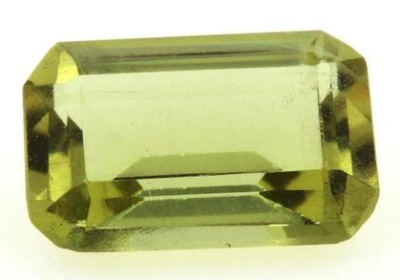 Figure 1. 1.47ct Apatite reportedly from Brazil sold as green euclase
| Shape | emerald / step cut |
| Size | 8,7 x 5,8 x 3,6 mm |
| Color | greenish-yellow |
| Lustre | just vitreous |
| Weight | 1.47 ct |
| SG | 3.27 |
| RI | 1.641 - 1.650, Uniaxial negative |
| DR | 0.009 |
| Pleochroism | strong greenish-yellow / gray |
| Polariscope / Conoscope | anisotropic / interference figures partially observed - optical character couldn't be determined |
| SWUV | inert |
| LWUV | inert |
| Observational features | facet edges are not very sharp but slightly rounded with few chips, hardness is likely below 7... |
Table 1. Observational and measured properties
Infrared reflectance spectroscopy:
Infrared reflectance spectrum was acquired from the table of the sample without any particular orientation.
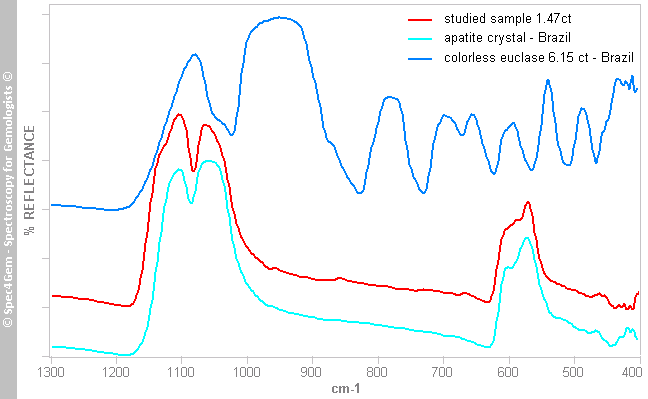 Figure 2. IR reflectance spectra of the studied sample (red), an colorless euclase from Brazil (blue) and yellow apatite crystal from Brazil (cyan).
Photoluminescence spectroscopy:
The gemstone is inert to the exposure to the short- and long-wave UV lamp, but a 405 nm 1 mW laser pointer produces a weak orangy luminescence. The photoluminescence spectrum was acquired with a 405 nm laser with a power of 20 mW. The laser ray was oriented approximately parallel and perpendicular to optical axis with no significant difference in spectra.
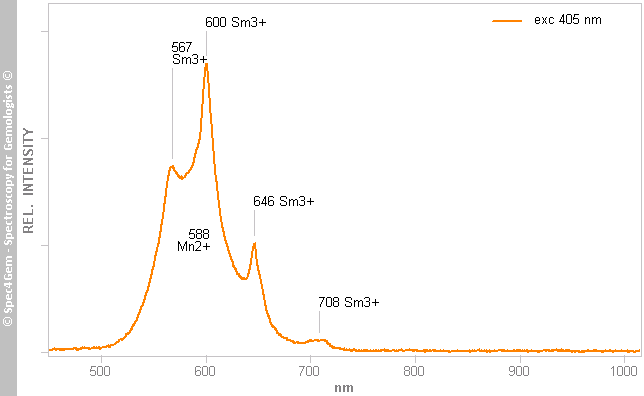 Figure 3. 405 nm excitation photoluminescence spectrum of the 1.47ct gemstone showing Mn2+ and Sm3+ replacing Ca2+.
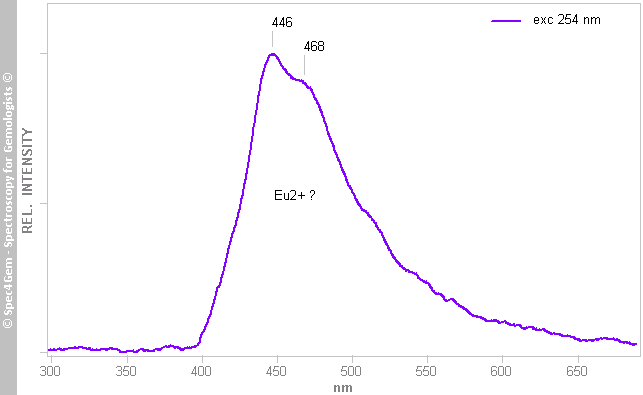 Figure 4. 254 nm excitation photoluminescence spectrum of the 1.47ct gemstone possibly showing Eu2+.
Discussion:
After the classical gemological tests and observational features, IR reflectance spectroscopy and photoluminescence spectroscopy, the 1.47 ct yellowish-green gemstone is an apatite but it is not an euclase as reported.