
Such 'vivid' sky blue color results from heat treatment of brown zircon found in the province of Ratanakiri (also spelled "Rattnak Kiri") in the extreme northeastern corner of Cambodia. There are some other sources of brown or reddish-brown zircon that heat to blue but a pale blue. These sources are the Pailin area (Thai/Cambodian border), Vietnam, and more recently Nigeria.
This heated blue zircon material from Cambodia is widely available since 2000.
It should be noted that all brown zircons from this source do not treat to this blue color, a lot turns to ugly colors or yellow (largely unstable color) and they can be heated again either to get blue or colorless zircons.
The blue color of zircon is not found in nature but it is supposed to exist in nature at the crystallization time. The blue color is then lost and replaced by mainly green and brown colors as a result of the metamict state of the material and centers both induced by the presence of uranium and thorium. The heat treatment partly reverts this phenomenon.
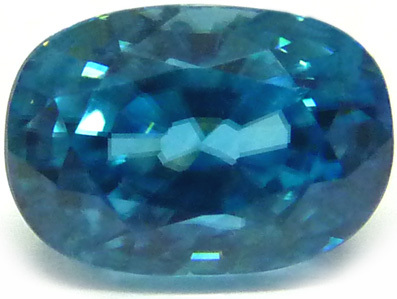 Figure 1: 6.19 ct heated 'vivid' sky blue zircon from Cambodia
| Shape | cushion |
| Size | 10.3 x 7.25 x 7.25 mm |
| Color | greenish-blue (strong sky blue) |
| Lustre | sub-adamantine |
| Weight | 6.19 ct |
| SG | 4.75 |
| RI | ~ 1.87 (mesured by reflectivity) |
| DR | not mesured but it is rather high since doubled facets edges can be easily observed with the unaided eye |
| Pleochroism | greenish-blue (strong sky blue) / grayish to colorless |
| Polariscope / Conoscope | shows some anomalous extinctions in some directions, uniaxial property could not be verified |
| SWUV | inert |
| LWUV | inert |
| Magnetic susceptibility | none |
Table 1: Observational and measured properties
UV-VIS-NIR spectroscopy:
The UV-Vis and NIR spectra were acquired to get the spectrum of the ordinary ray (E_|_c) and the spectrum of the extra-ordinary ray (~E || c). Unfortunately even if it was easy to get the ordinary ray spectrum (the blue color), it was almost impossible to get a pure spectrum of the extra-ordinary spectrum (the colorless) on a cut stone without using a polarizer or re-cutting the stone!
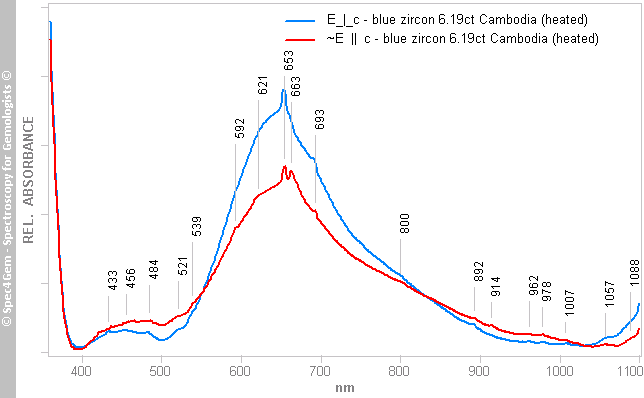 Figure 2: UV-Vis-NIR spectra of the heated 6.19ct blue zircon from Cambodia. The blue spectrum is from the ordinary ray (E_|_c) which gives its blue color to the stone and the red spectrum is almost from the extra-ordinary ray (E || c) associated to the colorless light path. Both spectra show a least 15 sharp absorption bands.
 Both spectra are very similar with a lot of sharp bands spread over the all spectrum from violet to the PIR. There is a transmission window between 380nm and 540nm delimited by a cut-off at 380nm and a strong asymmetric absorption region ranging from 540nm to almost 900nm. The transmission window gives the blue color to the stone since some green, yellow and red are absorbed. The large asymmetric absorption band from 500nm to 900nm is known to be caused by U4+ substituting of Zr4+ (Gaft, Reisfeld and Panczer [1]).
As mentioned earlier, the extra-ordinary ray (E || c) spectrum shows an anomalous absorption from 540nm to 900nm similar to that of the ordinary ray (E_|_c). The later is possibly caused by the presence of the ordinary-ray in the spectrum due to the difficulty to split both ray while acquiring the spectrum. Usually, it should show a flat spectrum starting from the 380 nm cut-off up to the NIR region with only the superimposed U4+ sharp bands. Despite that, the 663nm band is present and is characteristic of the the extra-ordinary ray, this band being much more prominent in the extra-ordinary ray than in the ordinary ray.
Photoluminescence spectroscopy:
The 405 nm laser ray was hitting the stone perpendicularly to its table and that direction is not that of the crystal axis. The obtained signal was rather weak even with the power of 20 mW of the laser. Note that no luminescence was observable to the eye.
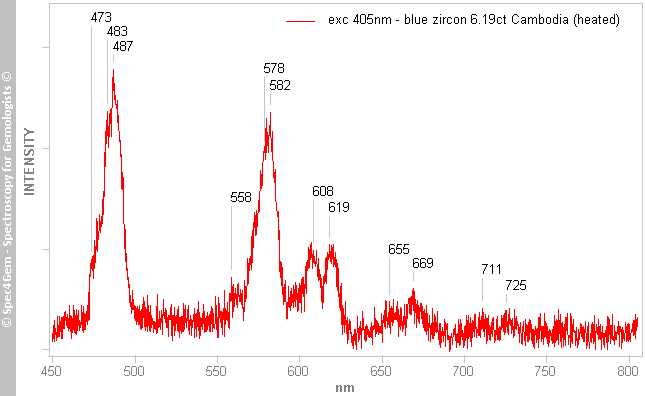 Figure 3: Photoluminescence spectrum of the heated 6.19 ct blue zircon obtained at room temperature with a 405 nm excitation source.
The reproduction of the phtoluminescence spectrum as shown in figure 3 was deliberately truncated to 800nm since no feature was observable between 800 and 1000 nm. The luminescence induced by the 405 nm excitation is composed of two main groups of emissions around 480 nm and 580 nm together with a group around 610 nm and followed by two weak groups around 660 and 720 nm.
The band assignments after Gaft, Reisfeld and Panczer [1] are given in the Table 2, all related to REE especially Dy3+ and Sm3+. The luminescence does not show any evidence of radiation induced centers luminescence, likely they have been reverted during the heating process. The luminescence of (UO2)2+ ion is also not observable.
| Band (nm) | REE assignment |
| 473 483 487 |
Dy3+ |
| 558 | Er3+ |
| 578 582 |
Dy3+ |
| 608 | Sm3+, Pr3+ |
| 619 | Sm3+, Pr3+ |
| 655 | Sm3+, Pr3+ |
| 669 | Sm3+, Ho3+ |
| 711 | Sm3+, Eu3+ |
| 725 | Sm3+ |
Table 2: List of the emission bands and their possible assignments.
Conclusion:
This zircon from Cambodia owes its blue color to U4+ ions substituting Zr4+ and to the heating treatment that reverted the radiation damage causing the brown color. Additionally, U4+ is along with REE like Dy3+ and Sm3+ as revealed by the photoluminescence spectroscopy.