
As a gemological rarity, the green kyanite offers an interesting palette of green colors, especially such a rare yellowish-green. The gemstones are rather clean for kyanites weighting between 0.40 and 3.00 ct. The rough was initially available at 2012 edition of Tucson shows. The faceted stones were then shown during the 2014 Tucson shows. Three samples of the faceted material are presented in figure 1, from top to bottom and left to right, the gemstones respectively weight 0.65, 2.96 and 1.40 ct.
The material reportedly comes from an unknown locality in Madagascar.
All data published in this report, pertaining to the 2.96 ct gemstone, are identical to that of the two other samples.
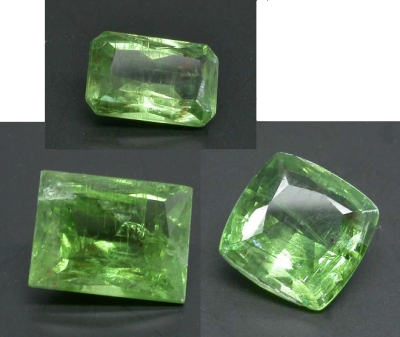 Figure 1. From top to bottom and left to right, three yellowish-green
kyanites reportedly from Madagascar, respectively weight 0.65,
2.96 and 1.40 ct.
| Shape | rectangular cushion cut |
| Size |
9.4 x 7.2 x 4.5 mm |
| Color | yellowish-green |
| Lustre | sub-vitreous |
| Weight | 2.96 ct |
| SG | 3.71 |
| RI | 1.720 - 1.737 |
| DR | 0.017 U+ |
| Pleochroism | unobservable or inexistant |
| Polariscope / Conoscope | light/dark 4 times / 360° |
| SWUV | inert |
| LWUV | inert |
| Magnetic susceptibility | weak with N52 |
Table 1. Observational and measured properties
Infrared reflectance spectroscopy:
The IR reflectance spectrum (figure 2), acquired from the table, exhibits a characteristic spectrum of kyanite specie.
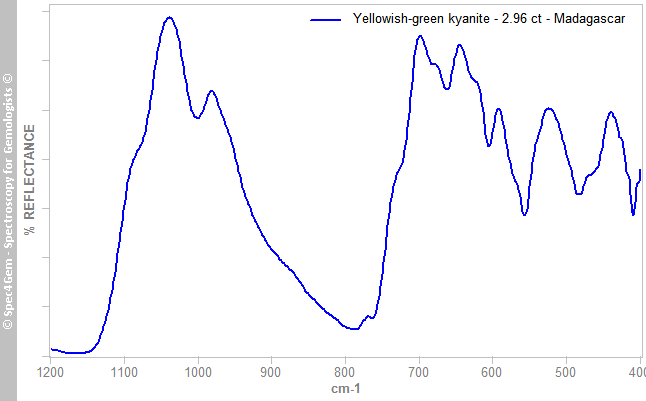 Figure 2. IR reflectance spectrum of the 2.96 ct yellowish-green kyanite from Madagascar, acquired from the table, exibits the characteristic spectrum of kyanite specie.
 UV-VIS-NIR spectroscopy:
The UV-Vis-NIR absorption spectrum (figure 3) was acquired with the light path perpendicular to the table with the light entering the pavilion.
The unpolarized UV-Vis-NIR absorption spectrum exhibits features at 371, 432 and 445 nm related to Fe3+ as well as the broad band centered at 617 nm (Faye and Nickel, 1969)[2], (Parkin et al., 1977)[1]. Not visible in figure 3, but visible in the spectrum if zoomed in, weak features unambiguously attributed to Cr3+ are also present at 650, 670, 689 and 707 nm. The Fe2+↔Fe3+ IVCT (Faye and Nickel, 1969)[2] is excluded for explaining the 617 nm band because the Fe2+ CF transitions absorption band in the 780-850 nm region (Faye and Nickel, 1969)[2] is not observed in this spectrum.
The 617 nm band is comparatively weak compared to the Fe3+ doublet at 433 and 446 nm, green and yellow are weakly absorbed / strongly transmitted, giving thus the yellowish-green color to the gemstone material.
A shoulder is present at 462 nm on the right hand side of the Fe3+ doublet. This shoulder is almost present in all kyanite spectra showing the Fe3+ doublet.
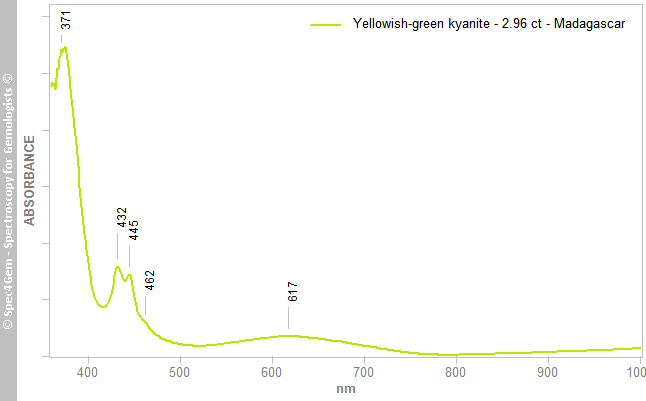 Figure 3. Unpolarized UV-Vis-NIR absorption spectrum of the 2.96 ct yellowish-green kyanite from Madagascar exhibits features at 371, 432 and 445 nm related to Fe3+ as well as a broad band centered at 617 nm. Not visible in this figure, but visible in the spectrum if zoomed in, weak features unambiguously attributed to Cr3+ are also present at 650, 670, 689 and 707 nm.
Photoluminescence spectroscopy:
Although the gemstone is inert under the SW and LW lamps, a 405 nm laser induces red luminescence. The photoluminescence spectrum (figure 4) with such excitation source was acquired without any specific orientation.
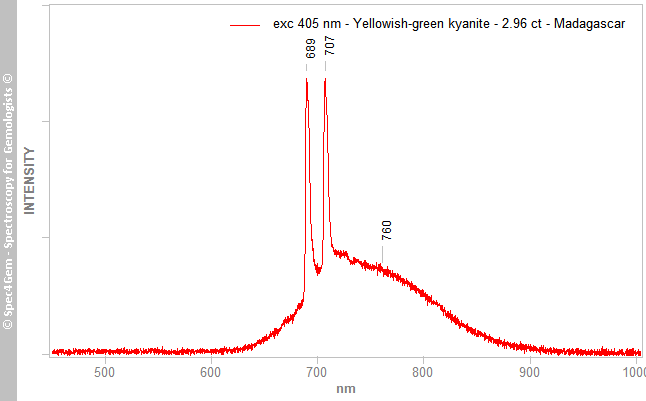 Figure 4. Photoluminescence spectrum of the 2.96 ct yellowish-green kyanite from Madagascar showing the Cr3+ R2 & R1 lines respectively at 689 and 707 nm as well as the 760 nm Cr3+ site B.
This yellowish-green kyanite shows a weak red luminescence attributed to the R2 & R1 lines of Cr3+ respectively at 689 and 707 nm (Gaft et al.)[5], these R lines are associated to the Cr3+ in site A. The 760 nm emission center (Cr3+ in site B) is also present.
Conclusion:
These kyanite rarities from Madagascar owe their yellowish-green color to the Fe3+ ions. Even if Cr3+ is present as shown by the photoluminescence spectroscopy it likely has few or no impact on the color.
Updates:
- These gemstones were later described by Brendan Laurs in his paper in the Gems Notes section: “Some Gemmological Rarities Seen in Tucson”, Journal of Gemmology, Vol. 34, No. 2 (2014 Summer edition), pp. 102–103.
[1] Mineralogical Applications of Crystal Field Theory, R. G. Burns, 2005, ISBN: 0521017858 | 978-0521017855
[2] On the origin of colour and pleohroism of kyanite, G. H. Faye, E. H. Nickel, The Canadian Mineralogist, Vol 30, No 35, 1969
[3] Blue colour-changing kyanite from East Africa, G. Bosshart et al., Journal of Gemmology, Vol. 18, No. 3, pp. 205–212
[4] Kyanite Visible Spectra - List of Visible Data Files on the Caltech Mineral Spectroscopy Server
[5] Modern Luminescence Spectroscopy of Minerals and Materials, 2nd Edition, M. Gaft, R. Reisfeld, G. Panczer, Springer Editor, ISBN: 9783319247632