
Two cabs of a white material with strong blue veins and few green veins, reportedly from Arizona, USA, weighing 8.95 and 5.37 ct, are studied in this report. As it can be observed on figure 1, the cabs' surface seem to be covered with an irregular thin pale yellowish film, looking like a varnish. Even if this was a varnish, the material overall appearance is rather dull.
The smallest cab (5.37 ct) got a try of cleaning with acetone solvent on a towel paper. After few second, scrubbing at the top of the cab, we got rid of the 'varnish', making the cab reveal its true color, slightly grayish white in comparison to the yellowish white as seen on figure 1. The cab did not seem to be polished and showed many flat surfaces unlike the biggest one. To give it a better luster, the cab was then slightly polished on a felt lap with cerium oxide.
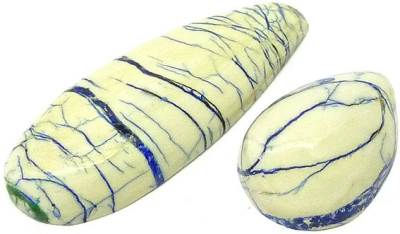 Figure 1: Two cabs of azurit in white material matrix
Infrared reflectance spectroscopy:
As the smallest cab (5.37 ct) was slightly polished, it was the best candidate to infrared reflectance spectroscopy. An attempt of spectra acquiring was made earlier on the uncleaned cab wearing its varnish skin without convincing results. The cab showing at least to main materials, the grayish white one that makes up the main body of the cab and the dark blue material filling the veins.
Focus was set on two area of the cab, the top which is only composed of the grayish white material and the one of the side which is composed of the dark blue and the grayish white material. The employed reflectance setup cannot focus on small points, only small areas not smaller than 5 mm x 5 mm can be used for acquiring spectra. As a consequence, acquiring spectra from areas composed of several material gives composite spectra.
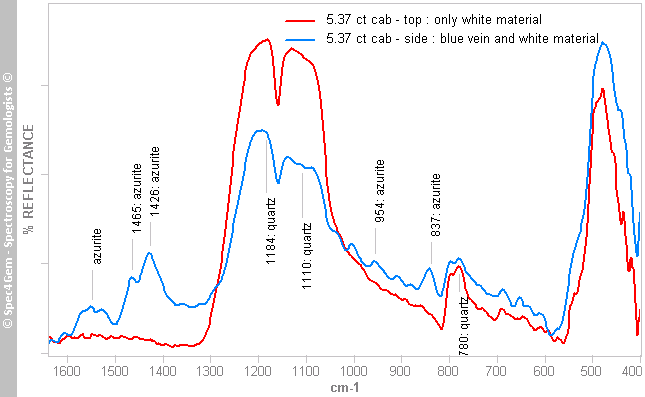 Figure 2: Infrared reflectance spectra of two areas of the 5.37 ct cab, one on the top where there is only the white material and the other one on the side where both materials are present. The spectrum of white material undoubtedly identifies quartz whereas the second spectrum shows the combination of two materials quartz and azurite.
The grayish white material from the top of the cab provides a spectrum (red spectrum in figure 2) that is typical of quartz mineral specie with its bands at 500, 540, 780, 800, 1110 and 1174 cm-1. A quartz reference spectrum is given in figure 3 for comparison. The second spectrum (blue spectrum in figure 2) shows the typical reflectance bands of quartz (780, 1110 and 1184 cm-1) that can be easily compared to others quartz spectra of the figure 2 and 3. This is consistent with the fact the spectrum results from an area where both materials are present. The bands located at 837, 954, 1426 and 1465 cm-1 are diagnostic for azurite, an azurite reference spectrum is given in figure 3 for comparison.
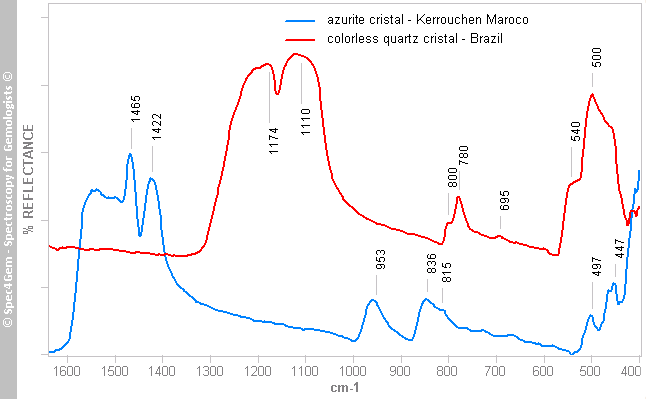 Figure 3: Infrared reflectance reference spectra of quartz and azurite. Spectra are normalized to the same % of reflectance and the quartz spectrum is offset for better clarity.
Discussion:
If it was quite clear that dark blue material was azurite, white materials was announced as limestone and it was not convincing. Polishing on felt lap with cerium oxide could have given quite fast results if it was limestone, but it took some efforts and time to start to initialize the polish, indicating the hardness was likely higher than that of limestone.
Infrared reflectance spectroscopy confirmed the nature of the cabs' materials after removing the film of 'varnish' covering them, the cabs are composed of grayish white quartz associated with dark blue azurite veins. There are few veins of green material, likely malachite, but that has not been verified.